
Please find the Chinese Version at [Chinese] The Life of Tommy Sec: Five Years Later

Paul Nguyen texting with Tommy Sec at Fairview in January of this year..
Paralyzed
A while ago I read about the story of NF-2 patient Tommy Sec first published five years ago on 51.ca. NF-2 is a genetic condition that causes tumors to grow on nerves. In 2014, Tommy underwent a high-risk operation to remove the tumors. Due to complications from the procedure, he suffered several strokes that left him paralyzed. He’s bed-ridden, unable to go outside, deaf and mute, with poor vision and can only use his left hand.
I was touched by Tommy’s harrowing story, so I reached out to Paul Nguyen. Paul has been helping Tommy and keeping in contact since they first met in 2017. I felt it was important to meet Tommy in person to check on his condition so I could share an update. I scheduled a visit to Fairview Nursing Home.
Fairview Nursing Home
Fairview nursing home is located inside a quiet neighbourhood, off Cross street at the corner of Gladstone Avenue, west of Toronto. The entrance is a narrow pathway leading to the parking lot that I barely noticed the first time I was there. Contrary to the warm and homey feelings of the neighborhood, the nursing home seems quiet and antiquated. A few cars were scattered around the parking lot but no one was around.
I rang the doorbell to ask for the code to enter the residence. It was late at night and the reception desk was left unattended. I stopped a staff member passing by to ask how I could find Tommy’s room. Without hesitation, she told me where to go and to register myself in the visitor’s log book at the front desk. Apparently, Tommy is a big name in the nursing home, as all the staff seem to know about him.
I got Tommy’s room number, but decided to wait for Paul to arrive. I didn’t want to startle Tommy since we had never met before. With a bit of spare time, I wandered around the facility.
An elderly lady was sitting in a wooden chair near the front desk. She looked at me curiously and opened her mouth, “Are you Chinese? Do you speak Mandarin?” I said yes, surprised that the first resident I met here was Chinese, too. We started talking. From our communication, I learned that she’s been living here for over 12 years since she was diagnosed with her disease- she didn’t specify what it was. She never got married and has no children or family. As a result, she said the best option for a single woman needing care was to register herself into a nursing home.
She looked content with her current situation, citing that the food there is to her liking. “My favorite food is spaghetti, especially with cheese and meat”, she started smiling when talking about it.
She pointed to the room in front of us and told me that’s the kitchen. “The meals are usually served there. They also have TVs in the room that we can watch while we have meals”, she introduced the facilities proudly as if it’s her own house.
Surviving the Pandemic
When Paul arrived, we walked together towards Tommy’s room at the end of the hallway. As I entered his room, I saw a long white curtain separating the room into two sections. A loud radio can be heard from the section opposite to Tommy’s area. I opened the curtain and saw Tommy snoring soundly in his bed.
Despite coming prepared by researching Tommy, my heart dropped a beat looking at how small he is. He was covered by a white blanket, outlined by his body, which is no bigger than a 14-year-old teenage boy. He looked so frail as if a gentle breeze could knock him down. His head is disproportionately big. His face looked pale and asymmetrical. The right side of his cheek was swollen and caused his mouth to tilt toward one side. His hair was cut very short, seemingly easier to maintain, yet it still looked like it hadn’t been groomed.
Tommy had a turbulent life- especially during COVID-19. Incredibly, he survived the Pandemic while unable to wear a mask, despite the fact that nursing homes across Ontario were particularly vulnerable to COVID-19 outbreaks. Many residents died at his nursing home. Visits were banned during the lockdown, and there was no way for Paul or anyone else to check in on him. Tommy previously applied for Medical Assistance in Dying (MAID) and was approved. But he withdrew at the last minute, as he wanted to reconnect with his estranged son, Kenny.
Paul and I stood there for a while, debating whether to wake him up. Probably feeling our movements, Tommy woke up and noticed our presence. He lifted his head up slightly, which might have been to the largest extent he was able, and acknowledged us.
Paul introduced me to Tommy by speaking to him, “Hi Tommy, my friend and I are here to visit you today. Her name is Phoebe and she will write a story about you.” With a little smile on his face,Tommy lifted his left hand and waved back and forth at me. I felt welcome and waved back. I was surprised that he seemed to have heard and understood what Paul was saying. “Can he hear us?”, I asked. “Of course not, he is deaf. But I want to treat him as normally as possible”, Paul said.
Tommy wants to say something. Paul went to grab his laptop. It is a 11” MacBook Air, looking aged and covered in food stains. After a few failed attempts, Paul managed to turn it on by keeping the charger plugged in. We found out that the battery doesn’t hold its charge anymore. On top of that, the charger is a magnetic plug, easily disconnected if the laptop is moved suddenly.
Electronic Lifeline
Bad news comes in two. Now the laptop requires us to input a Wi-Fi password when trying to connect to the internet. The internet has long been Tommy’s lifeline. The only channel in which he can communicate with the outside world, to socialize, stimulate his mind, or to ask for help. Anything that goes wrong with his electronic lifeline would completely isolate him. “How did it work before since the password should have been remembered automatically once entered?” I brought the laptop to the front desk, calling for help.
“Sorry but we don’t know. We don’t use the Wi-Fi here ourselves”, replied a staff member. “Is there anyone I can talk to about Wi-Fi?”, I asked. I didn’t want to give up on trying. “Yes, you may talk to room 310 and see what the lady there says about it”. I brought the laptop to the room and explained the situation.
“We can’t give you the password but I can enter it for you”, the lady said. She entered the password multiple times, but in vain. “How could it not work?”, she mumbled to herself.
“Are there any changes to the network lately?” I asked, knowing something must be off with the network.
“Yes, some technical people did network updates a few days ago. But I’m not sure if they changed the password or not”.
“Is there anyone else who may know about the change? Who is the service provider for the Wi-Fi here? We can contact them as well”, I prompted with more questions and as I was determined to figure it out.
“I can call the general manager and ask if they know about the update”, she said. With a ray of hope, I decided to relay the news to Tommy and take a break from standing for so long.
“I couldn’t believe no one knew about the password!” I complained in frustration. Maybe we are spoiled in the world where Wi-Fi is always available. I found it hard to accept that Tommy was left in the dark without it for so long. On the other hand, having the internet, or not, may have been the least concern in a nursing home.
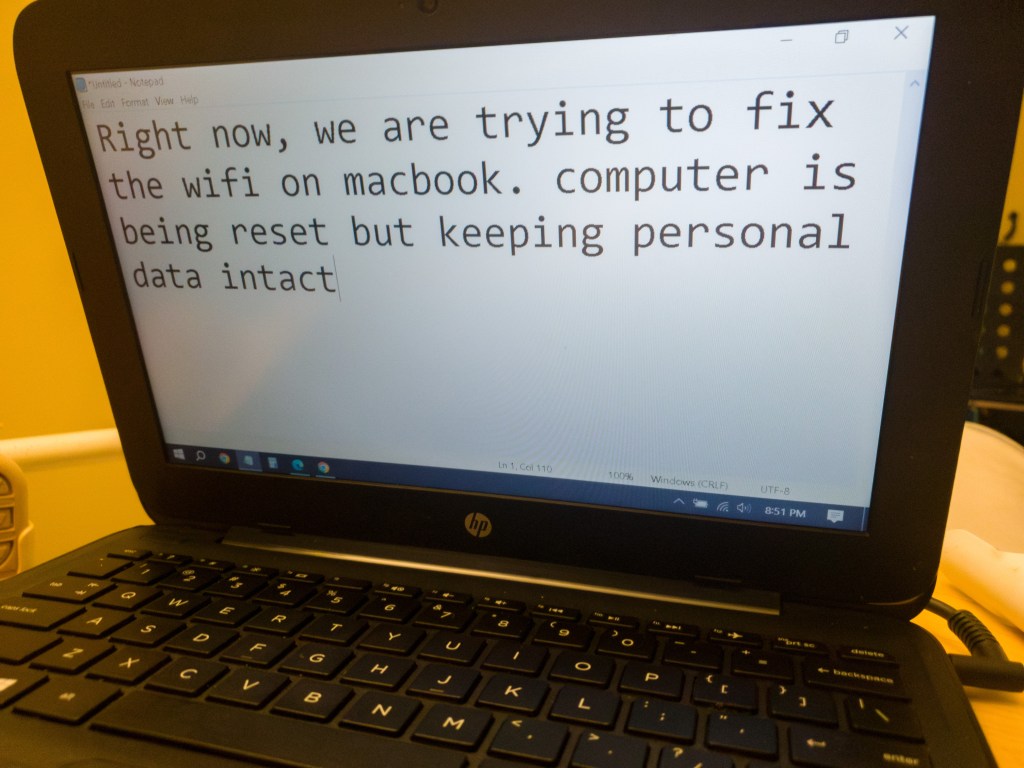
Coming prepared, Paul brought an extra laptop for Tommy knowing that he might have technical problems. He started typing on the screen to communicate with Tommy. Tommy’s health has significantly declined. “He used to type pretty fast on the keyboard. Now, even a simple yes or no is a lot of effort for him”, Paul added, having exchanged messages with Tommy online for years. Paul noticed the difference, adding that his physical ability appears to have deteriorated significantly, and that he seemed to have lost most of the dexterity in his left hand and finger.
With mixed feelings in my heart, I stood there in silence to process the unfortunate news. Paul was typing questions on the laptop, in the largest font size he can set it to. Tommy’s only functioning hand, the left hand, was bent in an unexplainable form. His thumb is curled outwards while the rest of fingers are bent inwards, which makes it extremely difficult for him to type. Watching him trying to type a “yes”, he had to search through the keyboard for the right key. He slowly but vigorously pressed the key, but sometimes it didn’t register the input. Sometimes he had to press several times for the letters to appear on screen.
Finally, we got confirmation from room 310 that the Wi-Fi issue has been resolved. I double-checked to make sure the web browser is working and announced the good news to Tommy. He nodded gently.
Despite being confined to his bed, he keeps well-informed about the outside world and he is skillful in using technology. He customized his laptop to fit his needs. However, with his deteriorating vision, he is having a hard time seeing the screen. When he realized he pressed the wrong button, frustrated by the move, he swept away the charger cord causing the laptop to turn off and reset the process. He threw his head back on the bed, made sighing noises, and frustration manifested through his eyes.
Standing next to him, I felt his frustration. Confined to a bed for years could drive anyone toward the edge. I witnessed the sheer effort and patience required of Tommy to complete simple tasks. During the lockdowns, mental health and well-being were among the biggest concerns to society. Not being able to go outside, meet people, or order favourite foods for months was testing everyone’s limits. It caused psychological problems in the population to spike, let alone Tommy, who has been living in such isolated conditions for years.
Now that the Pandemic is behind us, consider that Tommy has been left behind in isolation, with no hope whatsoever to live normally again.
Asking for Permission
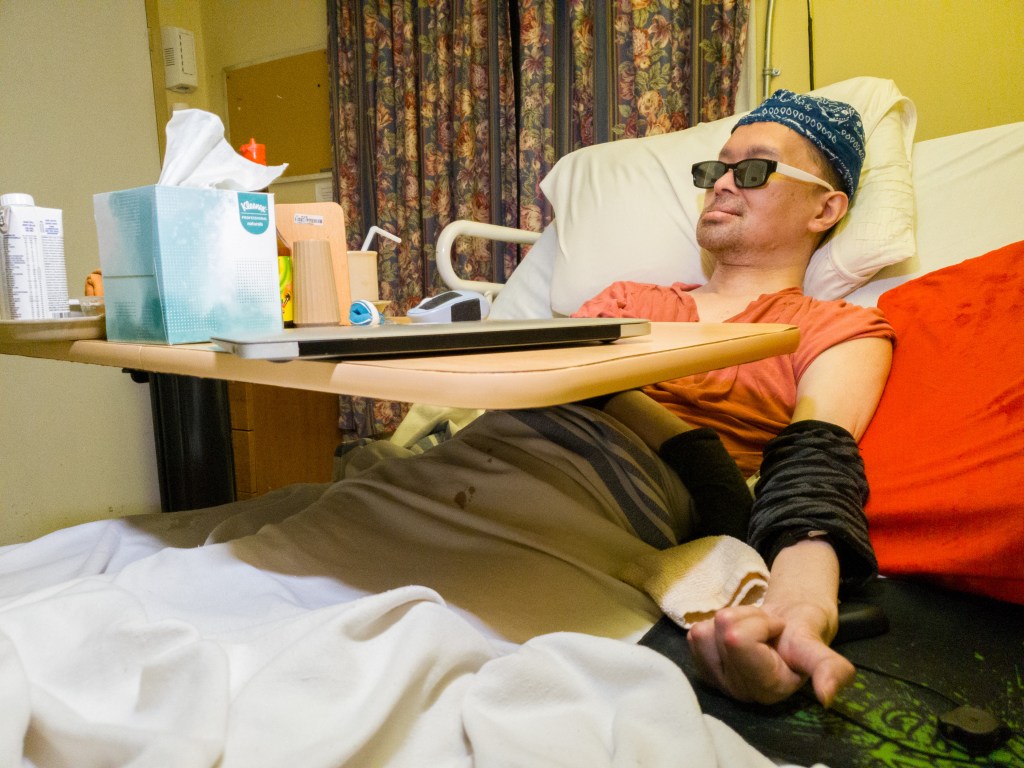
I asked Paul to take a few photos of Tommy to include with my article for 51.ca. Before proceeding, Paul typed out the question to ask Tommy for permission to take his photo. To protect Tommy, Paul is very clear and careful to consult with Tommy before performing any tasks or actions.
Tommy seemed to get a bit excited and wanted to look good for the camera. He typed “cap” on the screen. It took Paul a while to understand what he meant. “He likes to wear his cap”, Paul guessed correctly. Tommy continued to type “drawer” to indicate where it is. Paul started to search through all the drawers in the room. It turned out to be a blue and white patterned bandana. To secure it to his head, Paul tied the two strings at the back of it into a knot and placed it on his head.
Satisfied with his look, he posed for Paul’s cell phone camera. “He looked happy”, I thought to myself, knowing that it might be the only few things he could enjoy today.
Beef Congee
“Hey remember, I got beef congee for him?”, Paul said. The food is still sitting on the table. It was a request Tommy made a while ago while messaging Paul.
Tommy has a small hospital bed table, loaded with food and drinks, with a fan and his laptop. Not sure if he wanted to eat at all, Paul typed out the question. Instead of saying yes, he opened his mouth and made some incomprehensible sounds.
“What is he trying to say?” Paul was puzzled. “I think he wants to eat it now. He’s probably asking for us to call for a support worker”, I added with a smile, thinking that’s a rare moment he is trying to express more than just a yes or no.
As a person of Asian descent, Tommy said he misses his own cultural dishes, specifically Vietnamese and Chinese food. Living in a facility where the majority of food served is a Western-oriented diet, beef congee brings back memories and warmth of his Vietnamese upbringing.
A lot of time passed by due to the tasks and effort needed to cater to Tommy’s requests. From fixing his internet connection, to looking for his bandana- tasks that should only take seconds, end up taking far longer. It’s time to wrap up the visit and let Tommy rest. We had been there for three hours due to the tremendous challenges to communicate back and forth. I observed how Paul was very patient and knew how to anticipate certain things with Tommy. I suspect that others may not be so patient with Tommy.
We asked a nurse to help feed Tommy as we were prepared to leave. Paul took his laptop and told him he will check it at the computer repair shop. We both waved him goodbye. He waved back as we headed out the room.
A Stone’s Throw Away
Frankly speaking, it’s depressing for me to think of living or working in a nursing home where some residents are unable to communicate. Many of them require special care and attention, so the nursing staff in these types of facilities should be praised for their continued efforts.
Tommy’s situation is especially precarious – he is a stone’s throw away from complete social isolation because his body has failed him. If he loses use of his remaining functioning hand or vision in his working eye, he could be trapped with no way to communicate. A mind left in total darkness. Forever.
Nonetheless, I was impressed by the strong will to live that Tommy has shown. Throughout the years, he has been trying to be heard. He wrote a book, Unique in Canada, to share his story and teach lessons that he has learned from his ordeal. He started a Facebook group, Random Acts of Kindness, to raise awareness and bring strangers together who are facing similar health challenges. All of those things are done out of a desire to live, or in the worst case scenario, to leave a legacy behind.
He may not live as a hero who defeated the terror of the disease, but he will be a hero in the sense that he never gives up on trying. Yet, through years of fighting a lonely fight, with no hope of recovery. Many of us have learned the importance of mental health from going through two years of lockdowns. Tommy has been living through years of hopelessness, depression and social isolation.
The effects of the Pandemic were not unique to Tommy. The lack of awareness and treatment of mental health related issues are common among many patients and nursing/care home residents. While their body is being treated and taken care of, who is there to take care of their heart and mind?
The words Tommy typed on the screen when asked how he’s feeling inside summarized it succinctly:
“Maybe dead soon.”
If you want to reach out to Tommy or donate any items to help, please contact me at phoebeconnects@gmail.com or Paul Nguyen through his website, Jane-Finch.com.
 Phoebe Connects
Leave a comment